Key Takeaways
- Enhanced Safety and Compliance: A dedicated roof hatch eliminates the severe risks and liabilities associated with exterior ladders and temporary scaffolding, ensuring OSHA compliance.
- Operational Efficiency: Convenient, internal roof access streamlines routine maintenance for HVAC units, exhaust fans, and drainage systems, minimizing expensive operational downtime.
- Maintained Energy Efficiency: Modern commercial roof hatches feature insulated covers and double-sealed gaskets that preserve your building envelope and prevent costly air infiltration.
- Seamless Retrofitting Capabilities: Roof hatches can be expertly integrated into existing TPO, PVC, and EPDM roofing systems without compromising your watertight seal or manufacturer warranty.
- Long-Term Asset Protection: Easy access encourages proactive, regular inspections. Identifying minor wear early prevents major structural damage and extends the overall lifespan of your commercial roof.
When was the last time someone accessed your commercial roof? If your answer is “only when something breaks,” your facility is facing a significant problem.
Commercial roofs require regular inspections, proactive maintenance, and routine equipment servicing. HVAC units, exhaust fans, skylights, internal drains, and membrane seams all need periodic attention to function optimally. Without safe and reliable access, those critical routine tasks become inconvenient—and when access is inconvenient, maintenance gets delayed. That delay ultimately costs your business money.
At All Seasons Roofing, we are your premier commercial roofing contractors! We understand that installing a commercial roof hatch is not just a convenience upgrade. It is a vital safety improvement, a strict compliance measure, and a highly effective long-term asset protection strategy.
Why Safe Roof Access Matters
Commercial flat and low-slope roofs are simply not designed for casual access from the building perimeter. Utilizing exterior ladders, temporary scaffolding, or expensive mechanical lifts introduces unnecessary risk and massive liability to your property.
A properly installed commercial roof hatch provides:
- Controlled, secure internal access
- Significantly reduced fall exposure at roof edges
- Safer movement of maintenance personnel and contractors
- Easier, faster material handling for rooftop repairs
Instead of climbing up the exposed side of a building or navigating high parapet walls dangerously, maintenance personnel can safely access the roof from inside the facility using a fixed ladder or ship stair system. That structural upgrade alone drastically reduces the potential for accidents and protects your bottom line.
Are Roof Hatches Required by Building Codes?
Building code requirements vary by municipality, but the vast majority of commercial buildings must provide safe roof access for ongoing maintenance and life-safety purposes.
Even when not strictly mandated by local codes, roof hatches are considered an absolute best practice in:
- Large-scale warehouses and distribution centers
- Manufacturing and industrial facilities
- Schools and educational institutions
- Retail centers and shopping malls
- Multi-tenant commercial properties
If your facility houses rooftop equipment, safe access must exist. Ignoring access planning during construction or renovation often leads to improvised solutions later, and improvised solutions inevitably create severe safety concerns.
Operational Benefits Beyond Safety
Roof hatches do not just improve facility safety; they drastically improve your operational efficiency. Consider how frequently your rooftop equipment requires professional service:
- Seasonal HVAC inspections and filter replacements
- Exhaust fan maintenance and motor repairs
- Routine drain and scupper cleaning
- Bi-annual membrane and seam inspections
Without direct, internal access, each service call requires coordinating heavy exterior lifts, blocking customer or employee parking areas, increasing billable labor time, and adding unnecessary liability exposure.
A commercial roof hatch streamlines logistics and drastically reduces downtime. Our roofing solutions are designed for minimal business disruption, and providing safe access ensures that your facility continues to operate smoothly around the clock.
Built-In Safety Features
Modern commercial roof hatches are engineered with advanced, integrated safety components designed specifically to meet strict OSHA and fall protection standards.
Common high-performance features include:
- Telescoping ladder safety posts for completely stable entry and exit
- Integrated guardrail systems surrounding the roof opening
- Self-closing, spring-loaded gates to prevent accidental falls
- Durable, non-slip surfaces on all stepping areas
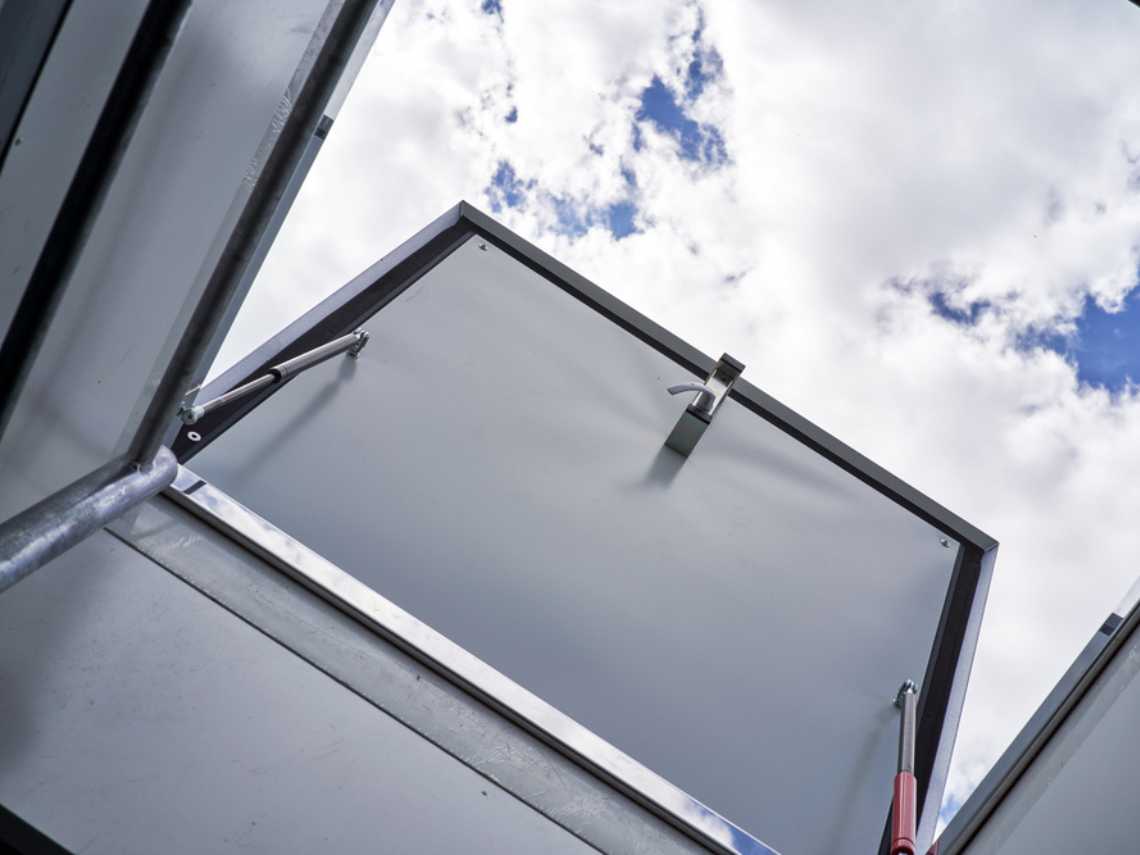
- Positive hold-open arms to secure the heavy hatch cover during windy conditions
These engineered features protect workers during both entry and exit—the two highest-risk moments during roof access. For property owners and facility managers, this proactive safety approach reduces liability and firmly supports regulatory compliance.
Energy Efficiency and Weather Protection
A very common concern among property managers is whether cutting an opening in the roof deck compromises insulation or waterproofing. When properly installed by certified professionals, it absolutely does not.
High-quality commercial roof hatches include:
- Fully insulated covers to maintain R-value
- Double-sealed, EPDM rubber gaskets
- Condensation-resistant structural construction
- Weather-tight curb integration
These premium features completely prevent air infiltration, thermal heat transfer, and destructive moisture intrusion. In climate-controlled facilities, insulated roof hatches help maintain strict building envelope integrity while still providing necessary access. Poorly installed hatches can create devastating leaks, which is exactly why professional installation by specialized contractors matters.
Material Options for Different Environments
Not every commercial building faces the exact same environmental conditions. Roof hatches are typically available in several durable materials to match your specific needs:
Galvanized Steel
A highly durable and budget-friendly option coated with a corrosion-resistant finish. This is highly suitable for standard commercial and retail environments.
Aluminum
Exceptionally lightweight and naturally corrosion-resistant. Aluminum hatches are ideal for facilities requiring low maintenance and easy operation.
Stainless Steel
The absolute premium option designed for the harshest environments, including coastal areas with salt spray or heavy industrial sites with constant chemical exposure.
Selecting the precise material ensures long-term durability, reduces ongoing maintenance requirements, and perfectly aligns with your facility’s budget.
Retrofitting a Roof Hatch into an Existing Building
Many commercial building owners incorrectly assume that roof hatches can only be installed during the initial new construction phase. That is simply not the case.
Roof hatches can be seamlessly retrofitted into almost all flat or low-slope commercial roofing systems, including TPO, PVC, and EPDM. The precision process typically includes:
- Evaluating the existing structural deck support
- Cutting a perfectly sized, clean roof opening
- Installing a heavily reinforced mounting curb
- Expertly integrating flashing with the existing roofing membrane
- Sealing and insulating the entire assembly to manufacturer specifications
When installed by a true commercial roofing professional, the new hatch integrates seamlessly into the existing roofing system without compromising your No Dollar Limit (NDL) warranty or your watertight performance.
Long-Term Asset Protection
Here is the bigger picture for commercial property owners: roofs last significantly longer when they are inspected regularly.
If access is difficult or dangerous, critical inspections get skipped. When inspections get skipped, minor issues—like a small puncture or a clogged drain—rapidly become major, expensive structural repairs. A commercial roof hatch actively encourages proactive maintenance because it completely removes the physical barrier to access.
This translates to:
- Much faster response times to active leaks
- Earlier identification of membrane wear and tear
- Proper, consistent drain cleaning to prevent ponding water
- Reduced risk of catastrophic storm damage
- Better, more consistent documentation for insurance claims
In short, roof hatches support a maintenance-first mindset. Regular maintenance directly extends the lifespan of your roof, providing an excellent return on your initial investment.
Work with a True Commercial Roofing Professional
A commercial roof hatch is a relatively small building component that delivers a massive operational impact. It improves safety, simplifies routine maintenance, reduces your legal liability, and fiercely protects your roofing investment.
If your facility relies on rooftop equipment but lacks dedicated internal access, it is time to upgrade your infrastructure. As experienced commercial roofing contractors, we specialize in a variety of roofing systems including TPO roofing, EPDM roofing, PVC roofing, and liquid roofing. We use only the highest quality materials and our team of skilled roofers are trained to handle any job, big or small, cementing our reputation as a top commercial roofing company.
Contact us today to schedule a consultation and find out how we can help you protect your business with a reliable, long-lasting roofing system.

Frequently Asked Questions (FAQ)
1. Will retrofitting a roof hatch void my existing commercial roof warranty?
Not when installed correctly by a certified professional. Expert installation ensures the hatch curb is flashed, sealed, and integrated exactly according to your specific manufacturer’s rigorous standards, keeping your warranty fully intact.
2. How often should my commercial roof hatch be inspected?
We highly recommend inspecting your roof hatch at least annually—ideally during your routine bi-annual commercial roof maintenance visits. Hinges, rubber weather seals, locking hardware, and all integrated safety components must be thoroughly checked for optimal performance.
3. What size roof hatch does my facility need?
The required size depends entirely on your specific usage. Standard personnel access typically requires smaller openings (e.g., 36″ x 30″), while equipment transfer for HVAC components may require significantly larger, double-leaf models. Our experts can evaluate your needs and recommend the perfect dimensions.
4. Does installing a roof hatch negatively impact my building’s energy efficiency?
No. High-quality, modern commercial hatches feature continuous insulation and double weather-stripping. When professionally integrated into your roof assembly, they maintain exceptional thermal performance, prevent condensation, and keep your HVAC costs completely stable.
5. Can a roof hatch be installed while my business is operating?
Absolutely. Our team of experienced professionals provides top-notch roofing services designed for minimal business disruption. We carefully coordinate the installation process to ensure your daily operations continue smoothly without excessive noise or structural exposure.