Key Takeaways
- Retrofit vs. Tear-Off: A retrofit installs a new single-ply membrane system over your existing metal roof, eliminating the high labor costs, operational disruption, and landfill waste of a full tear-off replacement.
- Retrofit vs. Coating: Unlike coatings that can mask trapped moisture and recurring leaks, a retrofit creates an entirely new, fully warranted roofing assembly that addresses the root cause of metal roof failure.
- Improved Energy Efficiency: Adding rigid insulation and cover board during the retrofit boosts your building’s R-value, enhancing thermal performance and reducing heating and cooling costs.
- Manufacturer Warranty Access: Properly installed retrofit systems qualify for long-term manufacturer warranties, often including third-party inspections that verify quality and protect your investment.
- Minimal Disruption: Because the original metal roof stays in place as the substrate, installation is faster and your business can typically continue operating throughout the project.
If your commercial metal roof is leaking, aging, or becoming difficult to maintain, you may think your only option is a complete tear-off replacement.
In many cases, that’s not true.
A commercial metal roof retrofit allows building owners to install a new single-ply roofing system over an existing metal roof without removing the original roof assembly. Instead of tearing off thousands of square feet of metal panels, the existing roof remains in place and becomes the foundation for a new high-performance roofing system.
For many commercial and industrial buildings, retrofitting is one of the most cost-effective and least disruptive roofing solutions available.
This guide explains what a retrofit is, how the system works, and why more building owners are choosing retrofit systems using single-ply membrane systems.
What Is a Metal Roof Retrofit?
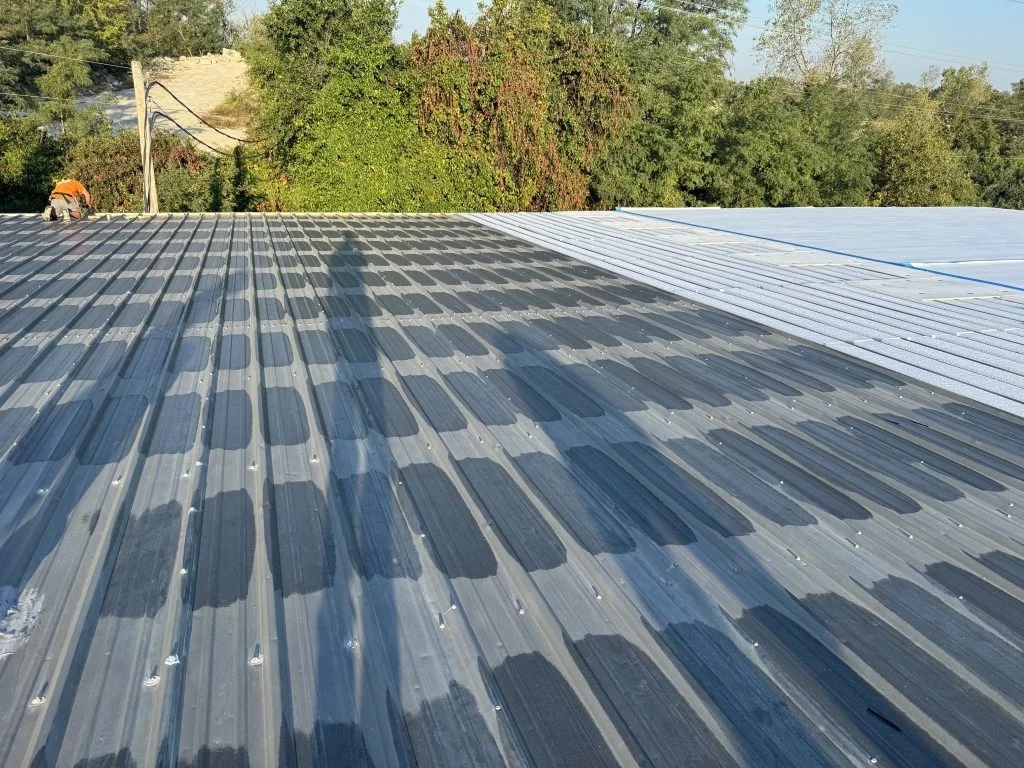
A retrofit is the process of installing a new roofing assembly over an existing metal roof system.
Instead of removing the existing metal roof, the retrofit uses that roof as a structural substrate for the new system.
The retrofit assembly typically includes:
- The existing metal roof remaining in place
- Flute-fill insulation cut to match the roof profile
- Rigid insulation and/or cover board
- A fully adhered single-ply membrane system
The result is a new watertight roofing system that eliminates many of the long-term problems associated with aging metal roofs.
Why Commercial Metal Roofs Eventually Fail
Metal roofs are durable, but they are not maintenance-free.
Over time, commercial metal roofs commonly develop issues such as:
- Fastener back-out
- Failed gaskets
- Seam separation
- Thermal movement
- Rust and corrosion
- Recurring leaks around penetrations
On large facilities, these issues become increasingly expensive to maintain. Building owners often find themselves repeatedly sealing fasteners or patching leaks without solving the underlying problem.
That’s where a retrofit system changes the conversation.

How a Retrofit System Works
A properly designed retrofit system is engineered as a complete roofing assembly—not simply a membrane installed over metal panels.
Step 1: Existing Metal Roof Evaluation
The first step is evaluating the existing roof to ensure it is structurally sound enough to remain in place as the substrate.
This includes checking:
- Panel condition
- Structural attachment
- Fastener integrity
- Drainage conditions
- Existing insulation performance
The goal is to determine whether the roof can support the retrofit assembly safely and effectively.
Step 2: Flute-Fill Insulation Installation
Metal roofs are not flat surfaces.
PBR panels and standing seam systems contain ribs and valleys that create uneven voids beneath the new roofing system. To address this, flute-fill insulation is installed.
Flute-fill insulation is:
- Cut to match the exact metal roof profile
- Installed between ribs and seams
- Used to create a more uniform substrate
This step prevents unsupported voids beneath the insulation package and helps stabilize the overall assembly.
Step 3: Cover Board and Insulation Installation
Once the flute spaces are filled, additional insulation and/or a cover board is installed across the roof surface.
This layer serves multiple purposes:
- Improves overall R-value
- Increases energy efficiency
- Creates a smooth substrate for the membrane
- Adds impact resistance
- Enhances long-term durability
High-density cover boards are commonly used to strengthen the assembly and improve puncture resistance.
Step 4: Installing the Single-Ply Membrane
Once the insulation assembly is complete, a fully adhered single-ply membrane is installed over the system.
The membrane creates a continuous watertight roofing surface that is independent of the movement and fasteners of the original metal roof.
This transforms the existing metal roof into a modern commercial roofing system designed for long-term performance.
Why Retrofit Instead of Tear-Off?
One of the biggest advantages of a retrofit system is avoiding a full tear-off.
A tear-off replacement often involves:
- Significant labor costs
- Interior exposure risks
- Operational disruption
- Landfill disposal costs
- Noise and debris
A retrofit minimizes these issues because the existing roof stays in place.
That means:
- Less disruption to building operations
- Faster installation timelines
- Reduced landfill waste
- Lower overall project costs in many situations
For warehouses, manufacturing facilities, and occupied commercial buildings, this can be a major advantage.
Why Retrofit Instead of Coating?
Many building owners consider coatings when metal roofs begin leaking.
Coatings can be an excellent option for extending the life of an existing metal roof when the roof is still structurally sound and largely leak-free. On roofs that are in good condition, coatings can improve reflectivity, help protect exposed metal, and add additional service life.
The problem is when coatings are applied to roofs that already have multiple active leaks, failing seams, saturated insulation, or long-term moisture intrusion.
At that point, coatings often begin masking problems instead of solving them.
Once water becomes trapped within the roofing assembly, additional issues can develop, including:
- Saturated insulation
- Loss of R-value
- Corrosion beneath the surface
- Adhesion failures
- Continued moisture migration
- Premature coating breakdown
Coatings also continue to rely on the original metal roof system performing properly. If fasteners continue backing out, seams continue moving, or moisture already exists below the panels, the underlying problems remain active.
A retrofit system is different because it creates an entirely new roofing assembly above the existing roof.
Unlike coatings, retrofits:
- Eliminate exposed fasteners as active leak points
- Reduce issues caused by metal movement
- Allow damaged areas to be addressed properly
- Improve insulation value
- Create a fully warranted roofing system
- Deliver longer-term performance
For building owners dealing with recurring leaks and ongoing repairs, retrofitting often becomes the more reliable long-term solution.

Additional Benefits of Retrofit Systems
Improved Energy Efficiency
Adding insulation during retrofit significantly improves thermal performance and can reduce heating and cooling costs.
Better Long-Term Maintenance
Single-ply systems simplify inspections and future repairs compared to aging metal roofs with thousands of fasteners.
Minimal Operational Downtime
Because the original roof remains in place, businesses can often continue operating during installation.
Manufacturer Warranty Options
Many retrofit systems qualify for long-term manufacturer warranties when installed by certified commercial roofing contractors.
These warranties often include third-party manufacturer inspections to verify proper installation.
Is Your Metal Roof a Good Candidate for Retrofit?
Not every roof qualifies for retrofit, but many do.
Retrofit systems are commonly used on:
- Warehouses
- Manufacturing facilities
- Agricultural buildings
- Retail buildings
- Distribution centers
- Large commercial facilities
The best way to determine eligibility is through a professional roof evaluation.
Work with a Commercial Roofing Contractor Who Understands Retrofit Systems
Retrofit systems require proper design, insulation planning, drainage evaluation, and membrane integration.
This is not simply “covering over” an old roof.
At All Seasons Roofing, we specialize in retrofitting existing commercial metal roofs using engineered single-ply membrane systems designed for long-term performance.
We help building owners:
- Evaluate retrofit options
- Improve energy efficiency
- Reduce recurring leak issues
- Minimize operational disruption
- Extend roof lifespan with fully integrated systems
A commercial metal roof retrofit is more than a repair—it’s a long-term roofing solution.
By using the existing metal roof as a structural substrate and installing a new insulated single-ply membrane system above it, building owners gain modern performance without the cost and disruption of a full tear-off.
If your metal roof is aging, leaking, or becoming difficult to maintain, a retrofit system may be the smartest next step.
Contact All Seasons Roofing today to schedule a commercial roof evaluation and learn whether a retrofit system is right for your building.

Frequently Asked Questions
How long does a commercial metal roof retrofit last?
When installed by a certified commercial roofing contractor using high-quality single-ply membranes and proper insulation, a retrofit system can deliver 20 to 30 years of reliable performance. Many retrofit assemblies qualify for long-term manufacturer warranties that reflect this extended lifespan.
Is a metal roof retrofit more cost-effective than a full replacement?
In most cases, yes. By using the existing metal roof as a structural substrate, a retrofit avoids the labor, tear-off, disposal, and downtime costs associated with a complete replacement. For warehouses, manufacturing plants, and other large facilities, this often translates to significant savings.
Will a retrofit disrupt my daily business operations?
Minimal disruption is one of the biggest advantages of a retrofit. Because the original roof remains in place, there is no interior exposure during installation. Most businesses can continue operating normally, and weekend or off-hours scheduling is often available to further reduce impact.
Can any metal roof be retrofitted?
Not every roof qualifies, but many do. The existing metal roof must be structurally sound enough to support the new assembly. A professional roof evaluation will assess panel condition, fastener integrity, structural attachment, and drainage to determine whether your building is a good candidate.
Does a retrofit improve energy efficiency?
Yes. Adding flute-fill insulation, rigid insulation, and a cover board during the retrofit significantly increases the roof’s R-value. This improved thermal performance can lower your heating and cooling costs while supporting sustainable building goals.
What single-ply membranes are used in a retrofit system?
Retrofit systems typically use durable, fully adhered single-ply membranes such as TPO, PVC, or EPDM. The right membrane depends on your building’s needs, climate conditions, and performance goals—something our experts can help you determine during a consultation.
Will a retrofit qualify for a manufacturer warranty?
When installed by a certified commercial roofing contractor, most retrofit systems qualify for long-term manufacturer warranties. These warranties often include third-party manufacturer inspections to verify that the system was installed to specification.
Meta Description: Discover how a commercial metal roof retrofit stops leaks, boosts efficiency, and avoids costly tear-offs. Learn if your building qualifies today.